THRIFT YOUR WAY
Thrift stores
Goodwill, Salvation Army, Savers and the hospice and church shops price thousands of donations a day, a few minutes each. That speed is why good things slip through.
Before you go
- Good for
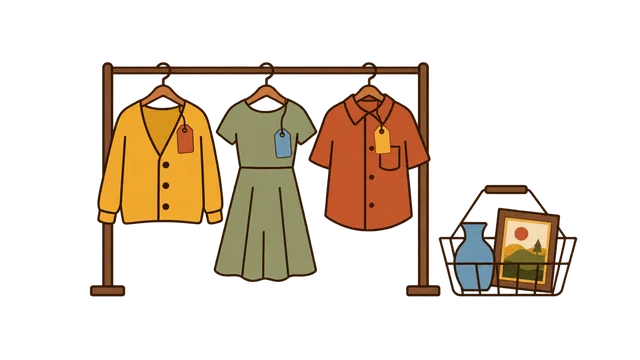
- Natural-fiber clothing, framed art, studio pottery and glass, solid-wood furniture
- When to go
- Weekday mornings, and the weeks after holidays and moving season
- Paying
- Fixed prices, with a weekly tag-color sale
How to do well
- Choose stores by their donors. A shop near older, well-off neighborhoods gets estate clear-outs; one near a campus fills with brand-name clothing every May and June.
- Learn the tag rotation. Many chains give each week’s stock a color and put an older color on sale, then pull what’s left after a few weeks. Something you like may be half off next week, or gone.
- Staff price by category, not by maker, so read what they had no time to. Turn pottery over for a maker’s mark, check labels for wool, silk, linen and cashmere, and look for dovetails and solid wood in drawers.
- Look behind the glass. Frames are priced as frames, and a signed print, an original or a good mat can be inside. Check the back for a gallery label, and the paper for the pressed rim of a plate mark.
- Find your nearest Goodwill outlet. These “bins” sell unsold stock by the pound before it leaves for good: dusty, competitive, and the cheapest good finds anywhere.
What to bring
Where to find them
Thrift stores near you
Your map app, on the charity and resale shops around you, with their hours.
Open your map: thrift stores near you (opens in a new tab)Goodwill outlets near you
Your map app, on the by-the-pound outlets, where unsold stock goes last.
Open your map: goodwill outlets near you (opens in a new tab)ShopGoodwill
Goodwill’s online auctions, where stores send their best pieces. Most lots ship.
Go to ShopGoodwill (opens in a new tab)
How Thriftcraft helps
Scan
Snap anything you’re unsure about. Decide at home, with the photo and price saved.
- Open Scan and take a photo of the find.
- Open the find to keep its price and notes together. Keep extra photos of marks and damage with it.
- If a snap is waiting offline, leave Thriftcraft open when you reconnect and check that it uploads before signing out.
More ways Thriftcraft can help
Places
Measure the spot you’re filling once, then check what fits while you shop.
- Use Places to keep the room, wall or shelf and the finds that belong there together.
- Open New place or Edit place to save its width, height and, where relevant, depth. Add the find to that place and use its Outside size control when measurements are missing.
- Places organizes where things belong; it does not automatically prove that furniture fits through a doorway.
Framing Bench
Found a frame? See which of your art fits its opening.
- Save both dimensions of the artwork and the frame’s usable opening. Unmeasured pieces can be kept, but cannot be matched yet.
- Use the Framing Bench to compare your saved art and frames. Both orientations are checked.
- Confirm depth, condition and the physical fit before buying; the size comparison cannot inspect the frame.
The sites here belong to other companies. None of them pays to be listed.